The renewable energy sector continues to gain momentum through strategic infrastructure investments, supportive government policies, and accelerating energy storage deployment. This week’s highlights showcase how collaboration between industry and government is expanding electric transportation infrastructure, improving fleet electrification incentives, and strengthening grid resilience through large-scale battery storage.
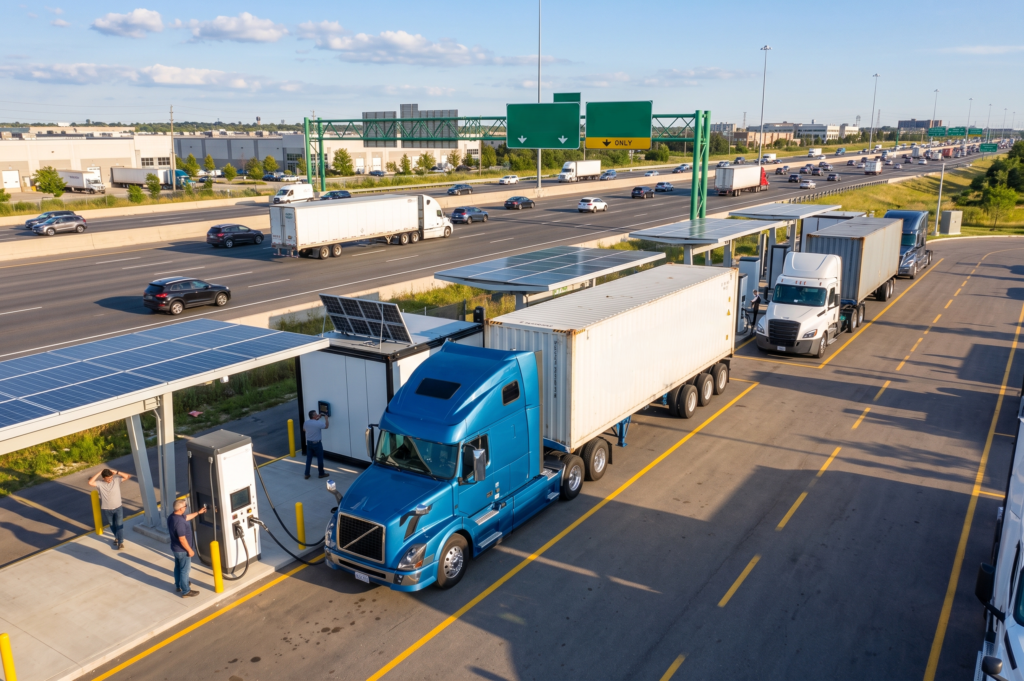
Quebec has reached an important milestone in heavy-duty transportation electrification with the opening of its first dedicated charging station for electric trucks along the Quebec City-Toronto travel corridor. Located at the Relais Routier Petit truck stop in Sainte-Hélène-de-Bagot, the site sits strategically along Highway 20 between Quebec City and Montreal, providing a convenient charging location for long-haul freight operators.
The project follows a Propulsion Québec study released earlier this year, which concluded that only seven strategically located charging stations would be needed to support electric truck travel between Quebec City and Toronto. Fully loaded Class 8 electric trucks typically achieve between 160 and 300 kilometres of driving range depending on weather, terrain, and vehicle model, making station placement a critical factor.
The charging infrastructure was supplied and installed by Chargepoly, while Québec’s Circuit Électrique owns and operates the facility. Designed specifically for commercial trucking, the site offers pull-through charging bays that allow large trucks to recharge without complicated maneuvering. Existing amenities including restaurants, restrooms, and established truck stop services further enhance convenience for drivers.
The station features a 480 kW power cabinet connected to two charging dispensers using CCS1 connectors. A single truck can receive up to 400 kW of charging power, while two trucks can simultaneously charge at up to 240 kW each. The modular “daisy chain” design allows additional charging dispensers to be added as demand increases, while future megawatt charging remains possible with expanded electrical capacity from Hydro-Québec.
Nationex, a Quebec-based trucking company, is already using the station to support its electric delivery fleet. Project partners hope the visible availability of dedicated charging infrastructure will encourage additional trucking companies to transition toward zero-emission vehicles.
Propulsion Québec continues working with partners to identify future charging locations west of the current site as development of the Quebec City-Toronto corridor progresses. Plans also include implementing a reservation system that will allow truck operators to reserve charging times and reduce waiting periods as station usage grows.
The Government of British Columbia is relaunching its Go Electric Rebates program for medium- and heavy-duty zero-emission vehicles beginning August 10, 2026. The program returns after funding was exhausted in August 2025 and introduces several improvements designed to better support fleet operators and simplify vehicle procurement.
Eligible businesses can receive rebates for up to five vehicles annually, while municipalities, Indigenous organizations, and non-profit organizations may apply for rebates on up to ten vehicles each year. These public and community organizations are also eligible for an additional 20% rebate top-up.
Available incentives range from $5,000 for eligible Class 2B vehicles to $130,000 for Class 8 trucks, with enhanced rebate amounts available through the top-up program. Rebate values remain subject to available funding and program eligibility requirements.
The revised program was developed through extensive stakeholder engagement led by CLEAResult Canada. The consultation process included 147 survey participants, six virtual workshops, and 32 individual interviews involving fleet managers, vehicle manufacturers, dealerships, industry associations, and academic experts.
One of the most significant improvements is the transition to point-of-sale rebates. Rather than requiring buyers to seek reimbursement after purchase, participating dealerships and sellers now process rebate applications directly, reducing administrative burden for fleet operators.
The program also introduces a pre-approval system that provides funding certainty before organizations finalize procurement decisions. Eligible applicants can reserve rebate funding for 60 days while selecting vehicles. Once a purchase or lease agreement is signed, funding remains secured for up to 12 months while waiting for vehicle delivery, with extensions available under certain circumstances.
To improve fairness and accessibility, funding will be released in four-month intake periods throughout the year, allowing more organizations the opportunity to participate as they complete procurement planning. Additionally, selected organizations affected by the previous funding pause may qualify for retroactive rebates on eligible Class 5 through Class 8 vehicle purchases made during the previous program period.
Participating organizations will also have opportunities to share their electrification experiences through interviews that highlight lessons learned and practical insights, helping other fleets better understand the benefits and challenges of adopting zero-emission vehicles.
The United States recorded its strongest first quarter ever for energy storage deployment, adding 3.3 GW and 8.4 GWh of new storage capacity during the opening months of 2026. According to Wood Mackenzie and the American Clean Power Association, utility-scale, residential, and commercial energy storage markets all achieved record first-quarter installation levels.
Industry forecasts project cumulative U.S. energy storage capacity will reach 200 GW and 655 GWh by 2031, representing approximately four times today’s installed capacity. This outlook aligns with the U.S. Energy Information Administration’s expectation that national energy storage capacity will double by the end of 2027.
Growing electricity demand continues to strengthen the market outlook. The EIA expects U.S. electricity consumption to increase by 76 billion kilowatt-hours in 2026 and by 126 billion kilowatt-hours in 2027, driven largely by commercial, industrial, and transportation sectors. Higher summer temperatures are also expected to increase electricity demand, with renewable generation projected to supply nearly all additional demand. Solar generation could increase by 19% this year, while wind generation may grow by 10%.
Solar and battery storage continue to dominate new power generation. During the first quarter of 2026, solar and storage accounted for 91% of all newly installed generating capacity in the United States. Nearly half of all new residential solar installations were paired with battery storage systems.
The continued availability of the federal investment tax credit for qualifying energy storage systems remains one of the primary drivers of industry growth. The tax incentive can offset 30% or more of deployment costs and provides greater investment certainty for developers even as tax incentives for some wind and solar projects are phased down.
Utility-scale energy storage is expected to account for approximately 85% of new capacity additions through 2031, supported by increasing demand from large electricity consumers pursuing colocated and behind-the-meter storage solutions. Commercial, community, and industrial storage is forecast to grow by 26%, while residential battery installations are expected to expand at an average annual rate of 12% after a temporary slowdown in 2026.
Domestic battery manufacturing is also expanding rapidly. Industry leaders report that U.S. factories now have sufficient production capacity to meet domestic demand, with several manufacturers shifting investments from electric vehicle batteries toward stationary energy storage systems.
This week’s developments demonstrate how infrastructure investment, government incentives, and advancing battery technology are working together to accelerate the transition toward cleaner transportation and more resilient electricity systems. Continued collaboration between governments, utilities, manufacturers, and industry stakeholders will play a vital role in scaling these initiatives over the coming years.
Stay informed with the latest developments shaping renewable energy, transportation electrification, and energy storage. As innovation continues across North America, these emerging trends are creating new opportunities for businesses, communities, and the broader clean energy transition.
 Connect with us on LinkedIn: DLVR